

The Deliverance
A Prayer for Those Who Have Forgotten Themselves

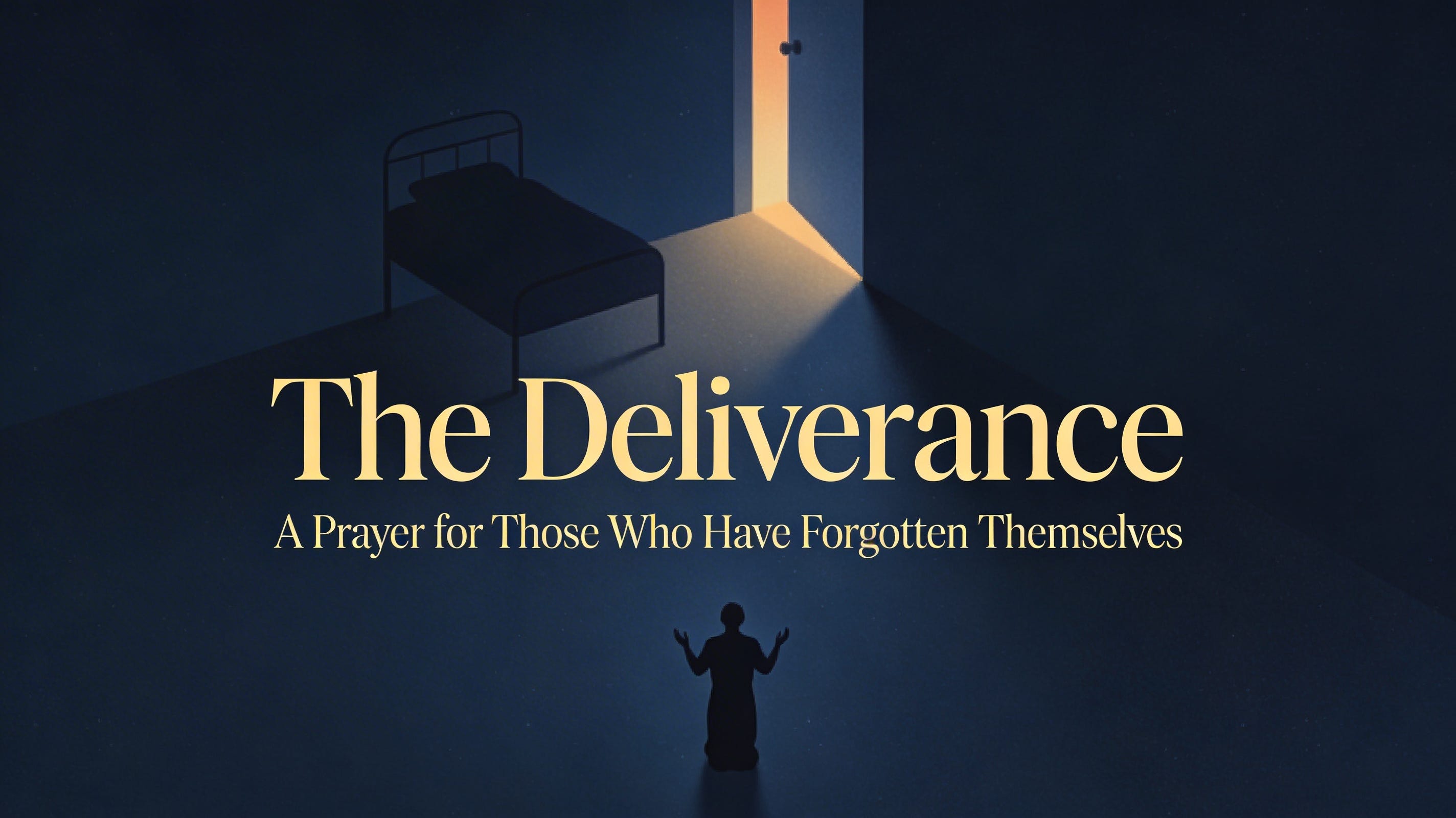
The Deliverance
One night you will finally break.
Not in front of a crowd, but in a small room that has heard all your other prayers and all your excuses.
The light will feel too bright. Your thoughts will be too loud.
Your arms will rise without permission, and a raw sentence will escape before you have time to soften it:
Who am I?
You will not sound holy. You will sound desperate.
Heaven has always answered desperate voices.
You will think, I should know this by now.
You will remember all the names you have worn, your job, your failures, the labels they gave you, the names you secretly gave yourself.
None of them fit anymore. They fall to the floor like clothes that no longer belong to your body.
Do not be ashamed.
You have merely joined an ancient conversation.
There was a man once, tending borrowed sheep in a borrowed land. His name was Moses.
He had run from his past and settled for survival.
In the ordinary field of his escape, a bush caught fire and did not burn out.
Out of that flame, a voice called him by name and said, I have seen the misery of my people. I will send you to them.
Moses, who had already failed once and buried his mistakes in the sand, answered with the same question that trembles in your throat:
Who am I that I should go?
Listen carefully to the reply, because it is the same reply offered to you:
I will be with you.
God does not begin by explaining Moses to Moses.
He begins by giving Himself.
Later, when Moses asks for God’s own name, the answer is as strange as it is simple:
I am who I am.
The man who asks, Who am I? is sent to speak in the name of I AM.
The small question of the creature is swallowed inside the larger presence of the Creator.
This is the first movement of Deliverance.
You do not find yourself by staring at yourself.
You find yourself by standing before the One who simply is.
Another man sang the same mystery in the dark. His name was David.
O Lord, you have searched me and known me.
You know when I sit down and when I rise up.
You discern my thoughts from far away.
Before David ever asks Who am I? he admits something deeper.
He is already known.
His getting up, his lying down, his noble moments, his shameful ones.
Nothing in him is hidden from God’s sight.
You formed my inward parts.
You knitted me together in my mother’s womb.
I praise you, for I am fearfully and wonderfully made.
In these words, there is both trembling and relief.
Trembling, because he has never been hidden.
Relief, because he has never been accidental.
Someone wanted him here. Someone shaped his depths before any surface story was written.
This too is Deliverance.
Not escape from weakness, but the sudden awareness that your entire life has unfolded inside the knowledge of God.
Yet even outside the scriptures, another restless voice circles the same question.
A man of philosophy, listening not to prophets but to the ache inside every human life, once said:
Become who you are.
He saw that the greatest tragedy is not suffering, but a life lived at a distance from one’s own truth.
His words carry no altar, no burning bush, no psalm. Still, they press the wound:
Do not die as a stranger to yourself.
Alone, that sentence is a heavy stone.
If you must become who you are without God, you have to build yourself from nothing while the age shouts its instructions.
Be successful. Be admired. Be invulnerable.
Be whatever earns applause today.
Set that sentence beside Moses and David, and its weight begins to change.
If the One, who is I AM is with you,
if He searched you and knew you before you had language for your own heart,
then become who you are no longer means invent yourself.
It means grow into the person God already sees when He looks at you.
It is not a command to create. It is an invitation to agree.
So let us return to your room.
You stand beneath the unflattering light that shows every line in your face.
You are sick of your own voice, tired of the roles you perform, done with the surface answers.
Your arms rise. The old names fall.
The only honest sentence left is the ancient one:
Who am I?
In that moment you are closer to holy ground than you realize.
You are standing with Moses before the fire.
You are sitting beside David with ink black hands and a racing heart.
You are walking beside that restless philosopher who refused to live life on autopilot.
You are surrounded by a quiet cloud of people who have all, at some point, reached the end of their own explanations.
You may feel like darkness is closing in.
You may say with David, Surely the darkness shall cover me, and the light around me be night.
You may believe the question has arrived too late to change anything.
But hear how the song continues:
Even the darkness is not dark to you.
The night is bright as the day.
Your confusion is not His confusion.
Your darkness is not His darkness.
Deliverance does not mean you suddenly see clearly.
It means that, for the first time, you trust the One who always has.
What then does this deliverance look like?
It rarely looks like fireworks.
It does not always arrive as a voice in your ear or a heat in your skin.
Often it comes quietly, like a shift beneath the surface of your life.
You say, Who am I?
God answers, I am with you.
You say, I am lost.
God replies, I have never lost you.
You say, I do not recognize myself anymore.
God says, I have recognized you since before your first breath.
When those answers sink from your mind into your bones, the chains begin to loosen.
Chains of old stories.
Chains of inherited shame.
Chains of borrowed names and small destinies.
The circumstances around you may remain the same for a while.
But the center from which you live has moved.
Deliverance is not always the opening of a prison door.
Sometimes it is the realization that the door has been open for a long time,
and the courage to step through.
If that is where you find yourself, arms raised, eyes stinging, heart asking, do not rush past it.
Let Moses lend you his question.
Let David lend you his prayer.
Let that fierce voice that said Become who you are remind you that to refuse this moment would be to refuse your own life.
Say this slowly, even if your voice shakes:
Search me, O God, and know my heart.
Test me and know my anxious thoughts.
Point out anything in me that does not belong,
and lead me in the way that never ends.
Then be still.
The answer may not arrive as thunder.
But if you stay long enough, you may hear the same steady voice that once met a shepherd in the desert and called him by name:
I am with you.
That is the moment your Deliverance begins.

Having the courage to step through. Well said. Even more so, building an awareness to make the door that was always there, visible 🙏🏽
The small question of the creature swallowed inside the larger presence of the Creator - that's where the whole piece turns, and it earns it. Threading Moses, David and Nietzsche together without forcing the seams takes real care. The observation that "become who you are" shifts from a burden to an invitation the moment God is in the room is the kind of theological move that only works when the writing is this honest.